
The Nūjeva perspective
The Low Cortisol Epidemic
The whole world is chasing high cortisol as the culprit. The uncomfortable truth is the opposite: chronically low cortisol — the exhausted end-state of years of stress — is what actually drives modern chronic illness.
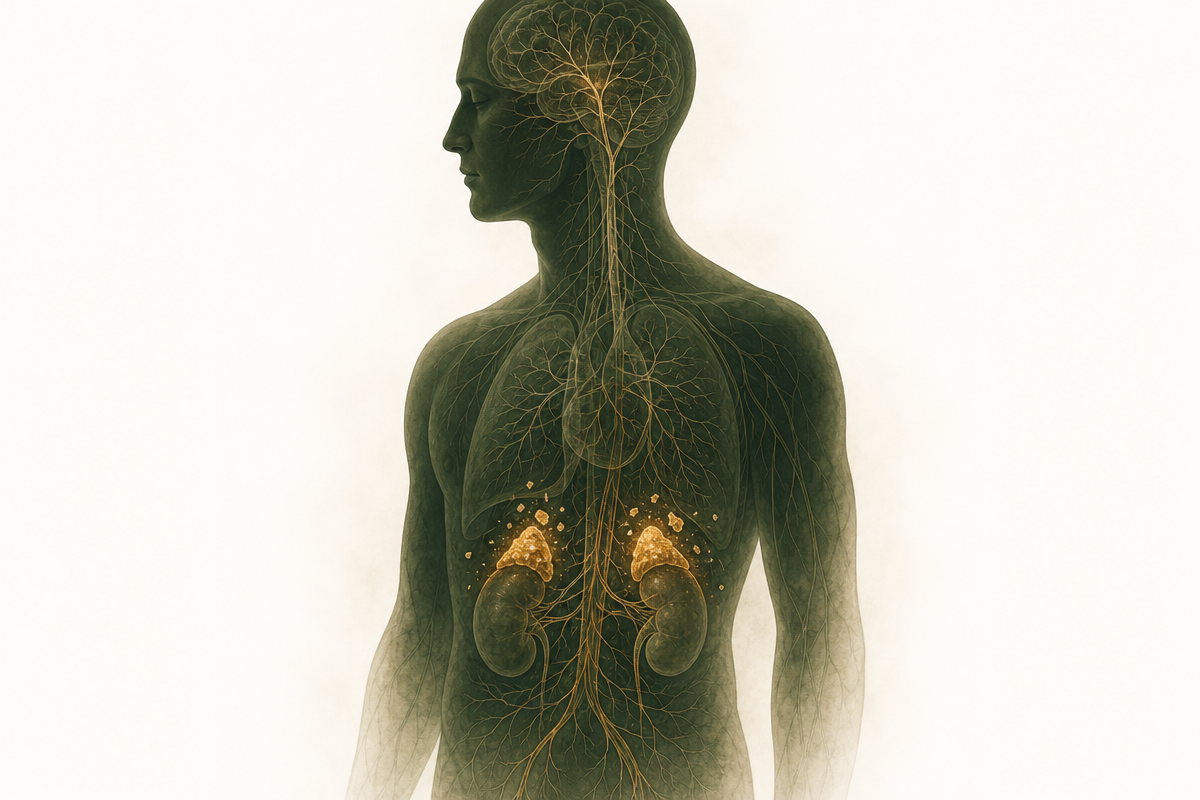
When the HPA axis collapses, every system downstream suffers.
of chronic fatigue patients show blunted morning cortisol in salivary testing
average time from first symptoms to a correct hypocortisolism diagnosis
most doctors rely on a single blood draw — missing the full diurnal curve entirely
The story we've been told
Wellness culture has settled on a simple villain: cortisol. Too much of it, we're told, is why you can't sleep, can't lose weight, and can't calm down. The shelves fill with "cortisol blockers." The advice is always the same — lower it, blunt it, suppress it.
That story is only half the curve. Cortisol follows a biphasic arc under chronic stress. In the early years, output spikes. But the adrenal system was never designed to run at 110% for a decade. Eventually the HPA axis dysregulates and cortisol output collapses. This end-state has a name in the literature: hypocortisolism — and it is far more common than the culture admits.
The full picture
What the diurnal curve actually looks like
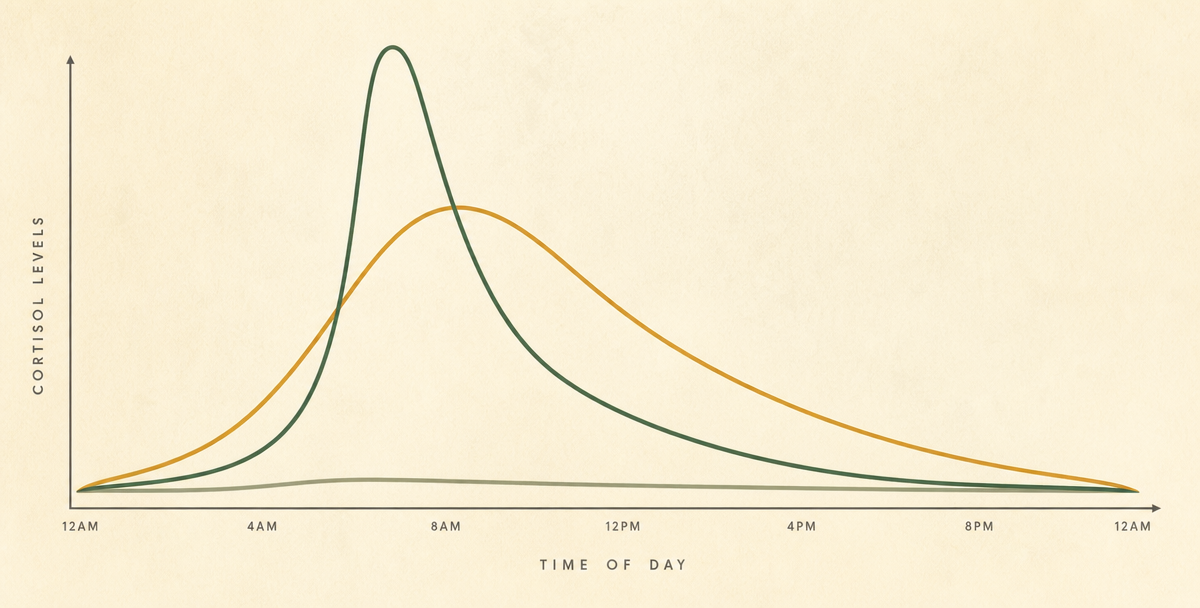
Healthy curve
Sharp morning peak, gentle decline
Acute stress spike
Short-term elevation, recoverable
Collapsed / low
Flat, depleted, unable to mount a response
System-wide effects
What low cortisol actually does
Cortisol isn't just a stress hormone. It regulates blood sugar, blood pressure, immune signaling, inflammation, and the daily rhythm that tells your body when to wake, eat, and repair. When it's chronically low, every one of those systems drifts:
Bone-deep fatigue
You wake tired even after 8 hours. Coffee stops working by 10 a.m.
Wired but exhausted
You crash all day, then get a false second wind at 10 p.m. that keeps you up.
Brain fog & low mood
Words slip. Motivation collapses. Small stress feels enormous.
Salt & sugar cravings
Your body signals a mineral and glucose emergency it can't regulate.
Frequent infections
Every cold lingers. Old inflammation flares. Autoimmunity ticks up.
Post-exertional crash
A single hard workout or stressful day wipes you out for days.
Self-assessment
Low-cortisol symptom checker
Check every statement that has been true for you most days over the past three months. Symptoms are weighted by how strongly they correlate with hypocortisolism in the clinical literature.
Energy
Stress response
Body & hormones
Cognition & mood
Select the symptoms that apply to you.
"The body is not a spreadsheet of isolated numbers; it is a dynamic, interconnected system."
Holistic interpretation is the only way to see the full picture
Real-world patterns
You've seen this before
A decade of 6 a.m. calls, red-eye flights, and 'just push through.' At 45 the labs finally show it: morning cortisol at the bottom of the range, DHEA half of normal. Not too much stress hormone — not enough left to make.
Marathons, ultras, fasted training. Chasing PRs while under-eating. Six months in: hair thinning, cycles disappearing, resting heart rate climbing. Overtraining syndrome is a low-cortisol state.
Symptoms overlap almost perfectly with adrenal insufficiency — fatigue, orthostatic intolerance, post-exertional malaise. Studies now find measurably lower morning cortisol in long-COVID cohorts.
Hashimoto's, RA, lupus — patients repeatedly show blunted cortisol curves. Without enough endogenous cortisol to modulate immune signaling, inflammation runs unchecked.
The Nūjeva approach
Rebuilding, not blocking
The answer isn't another cortisol blocker. It's rebuilding the raw materials and the rhythm the HPA axis needs to recover: mineral repletion, mitochondrial support, adaptogens that modulate instead of suppress, and — crucially — permission to actually rest. Nūjeva protocols are formulated around this end-state, not the fictional "everyone has too much cortisol" one.
Not all adaptogens help low cortisol
Most adaptogenic supplements on the market are formulated to lower cortisol. For someone in a true low-cortisol state, that is the opposite of what you need. Ashwagandha, rhodiola, and phosphatidylserine — popular "cortisol blockers" — can push an already depleted axis deeper into collapse.
If your morning cortisol is flat, your DHEA is low, and your stress tolerance has cratered, be very selective. The goal is not to block cortisol further; it is to give your body the raw materials, minerals, and cofactors it needs to rebuild its own healthy rhythm.
A dangerous condition hiding in plain sight
Chronic hypocortisolism is not a minor inconvenience — it is a serious, life-impairing condition that deserves proper evaluation. If you suspect your cortisol output has collapsed, you should seek comprehensive functional medical testing (salivary or urinary cortisol mapping across the full day, not a single morning blood draw) and work with a practitioner who interprets labs within the context of your symptoms, history, and lifestyle — not against a fragmented reference range.
Most conventional doctors miss this entirely. They look at one snapshot lab value, declare it "in range," and move on. They rarely ask about the shape of the diurnal curve, the slope from morning to night, or how your free cortisol compares to your total output. The body is not a spreadsheet of isolated numbers; it is a dynamic, interconnected system. Holistic interpretation is the only way to see the full picture.
Supplements alone are usually not enough. To truly recover, they must be paired with a high-quality, organic, whole-food diet that stabilizes blood sugar, reduces inflammatory load, and provides the micronutrients the adrenal cascade demands. In some cases — when the axis has been depleted for years — bio-identical hormonal replacement under qualified supervision may be necessary. Do not attempt to self-diagnose or self-treat severe adrenal insufficiency.
Formulated for the low-cortisol state
Nūjeva formulas that support HPA-axis recovery
Each of these targets a different lever of the low-cortisol picture: complete micronutrient repletion (Complete Multivitamin), structural protein support for tissue repair (Collagen), the sodium-potassium-magnesium electrolyte repletion a depleted adrenal system desperately needs (Hydration Powder), and the foundational cofactor the adrenal cascade depends on (Vitamin D3).
References & further reading
- Hypocortisolism and its role in chronic stress-related disordersPsychoneuroendocrinology (Fries, Hesse, Hellhammer)
- Reduced morning cortisol in Long COVID patientsNature — Klein et al.
- HPA-axis dysfunction in chronic fatigue syndromeNature Reviews Endocrinology
- Overtraining syndrome and the HPA axisSports Medicine
- Cortisol, inflammation, and autoimmunityNature Reviews Rheumatology